
WC Mastery Training
How to Measure Workers’ Comp Success with 5 Critical Metrics
Available On Demand
The path to workers’ compensation mastery is proven and well worn. One of the most critical elements to understand where you are in the path, and how far you’ve come, is to measure your workers’ compensation program.
DISCOUNT ENDS IN
The timer has expired!
Just $79
Retail $129.00
SAVE 40% WHILE THE TIMER ABOVE IS STILL COUNTING DOWN
What is More Important to Your Workers' Comp Program? Signage? Band-Aids?... Or Reducing Costs 20-50% and Improving Injured Worker Outcomes?
The question above is rhetorical.
Of course, the answer is "reducing costs and improving injured worker outcomes."
But they don't have to be mutually exclusive. You can have comprehensive safety signage and on-site medical facilities AND LOWER WC COST AND IMPROVED INJURY OUTCOMES.
Just ask any of the hundreds of risk managers, business owners, and brokers who improved their skills with our training―and then improved their bottom lines and their injured worker outcomes.
Clearly, they've all learned the 5 critical metrics proven to be key indicators of a best-in-class Workers' Compensation program.
In fact, by implementing the strategies and tactics taught in the Amaxx WC Training Center―based on 30+ years of top-level risk management experience―our students are able to minimize WC expenses and maximize employee safety, health, and productivity.
And we'll show you in this foundational workshop exactly how they've done it and how you can do the same for your business.
DISCOUNT ENDS IN
The timer has expired!
$79 | Retail $129 | Save 40%
Here's What You'll Learn ...
In this class you'll learn the keys to using metrics and why they're important, along with the step-by-step process to track your WC metrics and―most importantly―how to call attention to the impact and meaning of those metrics for your organization through your ability to tell an understandable and meaningful story.

Class Preview
Metric #1: Cost Per FTE
One of the most powerful and impactful metrics is Cost Per Full Time Equivalent Employee. This metric will allow you to tell a meaningful story in a snapshot.
The formula is: Incurred Losses multiplied by 2,000 then divided by Man-Hours.
Give Meaning to FTE Calculation
Using the above formula to calculate your cost per FTE only becomes valuable with a basis for comparison and tracking.
Use your cost per FTE for the following:
1) Compare to your industry in annual RIMS Benchmark Survey.
2) Compare to your own company by period to track improvement and savings to date.
3) Create and publish an internal worst to best list by division to create competition and peer pressure.
Metric #2: Sales to Pay for Accidents
The sales to pay for accidents metric is designed for one main reason: to compare workers' compensation costs to something meaningful at your organization.
The formula is: Incurred Losses divided by Profit Margin.
Profit Margin Example: Acme Corporation
• Incurred Losses = $1 m
• Profit Margin = 5%
Formula Applied: $1,000,000 multiplied by .05 = Acme Corporation needs to sell $20,000,000 in revenue to cover workers' compensation costs.
• How many widgets do you have to sell to get to $20m?
• Compare this number to something meaningful at your company, examples include cost of employees, machinery / equipment, and other costs - be creative.
Metric #3: Lag Time
One of the most common and easiest reports to track from your claims handler is your Lag Time Report. This report tells you how quickly, on average, employees report their injuries. This number can range between 1 – 15 days or greater.
In 2000 Hartford Insurance published a lag-time study based on 53,000 permanent partial and temporary claims. The results show how much more expensive claims become as each week passes compared to those reported in the first week:
• Reported within 2 weeks were 18% more expensive than within one week.
• Within 3 weeks: 29% more expensive...
• 4 weeks: 31%...
• 5 weeks: 45%...
Track this number by period and division, with the Cost Per FTE.
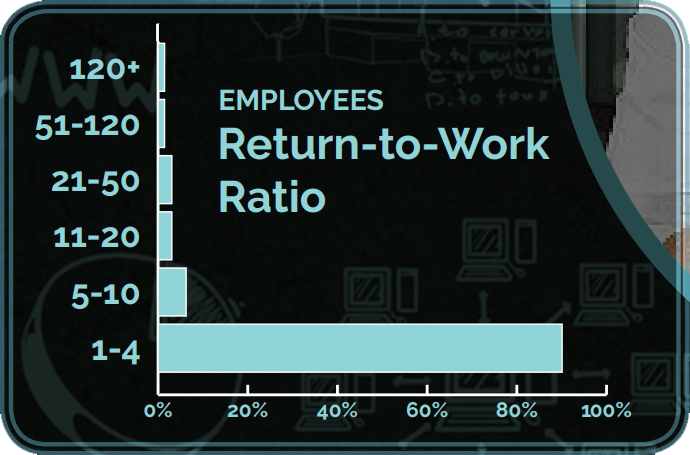
Metric #4: Return-to-Work Ratio
The Return to Work ratios is the ratio of employees that return to work following an injury within 0-4 days. The goal for your program should be > than 90% of your employees return to work in 0-4 days. Best-in-class programs will have at return to work ratios > 95%.
To track this ratio, compare the injury date to the date the employee returned to work. Your first goal is to get one employee back to work just one day sooner, then build on this success to create momentum toward positive change.
Metric #5: Number of Employee Out of Work Right Now
This metric is very simple, yet very powerful. How many employees are out of work at your organization right now? If you do not know how many employees are out of work, how are you going to get them back to work?
Your Instructor

Michael Stack is the Principal of Amaxx Risk Solutions. He is an expert in employer communication systems and helps employers reduce their workers comp costs by 20% to 50%. He resides in the Boston area and works as a Qualified Loss Management Program provider working with high experience modification factor companies in the Massachusetts State Risk Pool.
As the senior editor of Amaxx’s publishing division, Michael is on the cutting edge of innovation and thought leadership in workers compensation cost containment. He stays in tune with the latest industry challenges, and pursues partnerships with industry leaders to provide the go-to resource for best practices.
In almost every problem, Michael believes some facet of the cause is communication. In the case of Workers Compensation, poor communication is not only causing emotional strains on the employee and employer, but also unnecessary strain on the employer’s bottom line. He believes the root of a good Workers Comp Cost Reduction system must be Win-Win to be successful.
Michael brings a unique CPA background to the workers compensation space, and is highly in tune with the impact of workers compensation cost containment on a companies bottom line. He is dedicated to writing, speaking, and masterminding with others for the purpose of continuous improvement in an area so vitally important to companies and individuals.
FREQUENTLY ASKED QUESTIONS
How do I access the course?
This is an on-demand training class you can access anytime.
Once your payment is submitted, you will receive an email with your login details for this flagship product, How to Measure Workers' Comp Success with 5 Critical Metrics. where you'll be able to access the training curriculum. It's a go-at-your-own-pace class, so you don't have to worry about missing anything.
Who is the course for?
Risk managers are the primary work comp pros who take this class, but executive management and employee supervisors all need to understand and buy into the concept of continually recording and analyzing critical performance data.
Why metrics and why now?
Metrics are the numbers that don't lie about your business. Knowing which information to look at and how to properly formulate, analyze, and respond to the data you collect is really the only way to efficiently implement change in a complex regulated process that needs to facilitate and coordinate many internal and external stakeholders. Given the current climate in the business world, it's critical to immediately do all you can to reign in the exorbitant cost of an improperly managed WC program. This class provides a blueprint to understanding the impact of WC costs on your bottom line and how to go about building a more cost-efficient system.
How long does it take to complete this class?
Each master class is approximately one hour. The classes are broken into chunks of 5-15 minute sections and are separated with three short quizzes to improve your ability to apply the knowledge learned.
Most certifications require the completion of approximately 10 master classes, plus a final exam. Our most advanced certification, the Best-In-Class program requires 24 master classes. The classes could be completed in less than one month. However, the average time to complete the certification is 3-12 months.
The final exam takes 3-4 hours to complete.
Get this Class for Just $79
$79 | Retail $129 | Save 40%
DISCOUNT ENDS IN
The timer has expired!
Copyright - Amaxx LLC - All Rights Reserved